How to Manage Data Protection in Hybrid and Multicloud Environments
In an age when tech-savvy organizations are using multiple different clouds to accomplish several distinct goals, security becomes more important than ever. Most organizations can enforce strong security in their own datacenters and in a single cloud of their choice. However, achieving consistent security across clouds is a mystifying goal that eludes many of the most competent IT teams.
This guide walks through the key steps, strategies, and tools for building a strong, unified multicloud security posture.
Key Takeaways:
Securing a hybrid cloud environment starts with adopting a hybrid methodology that prioritizes security by design.
In the hybrid multicloud, where private datacenters connect to a single or multiple public clouds, IT administrators can take full control of security measures across all cloud locations using centralized management tools.
Maintaining strong cloud security practices in perpetuity can be easier than it sounds by adopting a dynamic philosophy for responding to risks, as well as adopting the right cloud technology that is equally dynamic.
The 3-2-1-0 backup rule (three data copies, two different media types, one offsite, zero errors) is the current industry standard for protecting data against ransomware and accidental loss in multicloud environments.
Zero-trust principles including MFA, role-based access controls (RBAC), and centralized encryption key management are the foundation of effective multicloud security.
Step 1: Understand Whether Cross-Cloud Security Is Achievable
Cloud security refers to the unique practices and policies that IT administrators must employ to protect data, maintain customer privacy, and ensure regulatory compliance in a complicated cloud environment. There are new intricacies to consider even when an organization deploys its first cloud, so the question naturally arises as to how IT teams can effectively achieve security across clouds.
Hybrid multicloud is the operating model of choice for organizations eager to maximize efficiency and perform seamless workload migration on demand. Securing this type of diverse and distributed environment is a challenge many decision-makers are facing, though.
Findings from Grand View Research show that the global multicloud management market size held an estimated value of USD 9.94 billion in 2023, with a projected compound annual growth rate of 28% from 2023 to 2030. Multicloud adoption will only grow from here, illustrating the increasing need for security across clouds.
There is a solution that makes it possible to achieve true multicloud security. It starts with a cloud platform that unveils the complexities of modern IT security and safeguards data in cloud-native deployments by design.
Step 2: Know the Specific Challenges of Multicloud Security
Before you can design an effective strategy, you need to understand why multicloud security is harder than securing a single environment. Each cloud provider operates under its own security model, toolset, and identity system. When you operate across AWS, Azure, and Google Cloud simultaneously, the gaps between those systems become your biggest vulnerabilities.
Inconsistent IAM policies across providers
The core issue is that each cloud uses its own IAM system, making it nearly impossible to apply a consistent set of user permissions and access controls across AWS, Azure, and Google Cloud. This leads to configuration drift, increased risk of over-permissioned accounts, and a larger surface area for accidental or malicious access.
Lack of unified visibility
Monitoring tools are often provider-specific, resulting in fragmented security dashboards and log data. This lack of a single pane of glass makes it difficult to correlate alerts, track malicious activity across cloud boundaries, and maintain a clear, continuous security posture, creating blind spots for IT and security teams.
Data sovereignty and compliance complexity
When data resides in multiple public cloud regions and sovereign territories, meeting diverse regulatory requirements like GDPR, CCPA, or industry-specific mandates becomes extremely complex. Organizations must track data location and ensure all cloud configurations comply with local laws simultaneously, a task prone to error without centralized control.
Encryption key fragmentation
Each cloud vendor requires its own system for creating, rotating, and managing encryption keys. This fragmentation creates significant operational overhead and heightens the risk of losing control over keys—especially customer-managed keys (BYOK)—which is critical for data sovereignty and audit compliance.
Backup and recovery inconsistency
Multicloud environments often utilize different backup and disaster recovery (DR) solutions for each provider, leading to inconsistent recovery standards, Service Level Agreements (SLAs), and recovery time objectives (RTOs). In a crisis, this inconsistency complicates the recovery process, making it slower and less reliable than a unified approach.
Step 3: Establish Your Hybrid Multicloud Security Foundation
In a multicloud environment, a lack of unified security becomes a point of concern for many IT administrators. Hybrid cloud, on the other hand, is a model that inherently strengthens security by empowering organizations to keep the most sensitive workloads closer to the chest in an on-premises datacenter while still capitalizing on cloud capabilities.
Nutanix Cloud Platform Security introduces platform hardening, security auditing, and comprehensive protection to hybrid multicloud deployments while addressing common concerns around data control. Nutanix embraces the philosophy of zero trust security, ensuring that only those within an organization who should have control over apps and data will get access to that control.
The right cloud service provider will be collaborative and communicative with consumers on security matters such as encryption, monitoring, and remote access procedures. This transparent approach to hybrid cloud security is necessary for truly unveiling the risks and challenges that are present in a company’s cloud infrastructure, leading to more effective security across clouds.
Unified security, transparent insights, and reduced complexity are all features of secure operations that are provided by Nutanix Security Central. As a part of the Nutanix Cloud Manager tool, Security Central makes it easy for IT operators to discover vulnerabilities, initiate automated security measures, and deploy infrastructure adjustments to help maintain regulatory compliance on-premises and in public clouds.
Step 4: Apply the Five Essential Multicloud Security Strategies
These five strategies address the core requirements identified by security practitioners and directly mirror what organizations are deploying to protect data across AWS, Azure, Google Cloud, and on-premises environments today.
Centralized Governance and Visibility (CSPM / CNAPP)
The fundamental requirement for securing a multicloud environment is achieving a single source of truth for your security posture. Centralized Cloud Security Posture Management (CSPM) and Cloud-Native Application Protection Platforms (CNAPP) provide unified visibility across all cloud and on-premises environments. This unified perspective eliminates security blind spots, allows for real-time risk assessment, and prevents the configuration drift that often results in serious vulnerabilities. By aggregating alerts and policies into a single dashboard, IT teams can consistently enforce governance and compliance standards across AWS, Azure, and Google Cloud simultaneously.
Unified Identity and Access Management (Zero Trust / MFA / RBAC)
Identity is the new security perimeter in multicloud. By applying Zero Trust principles, organizations verify every user and device attempting to access resources, regardless of location. This is achieved through mandatory multi-factor authentication (MFA) and strict role-based access controls (RBAC) that adhere to the principle of least privilege. In a multicloud context, a unified IAM solution ensures that a user granted access to a resource in an on-premises datacenter has an identical, properly controlled level of access when interacting with a workload in a public cloud, preventing over-permissioning and reducing lateral movement for attackers.
Robust Encryption and Key Management (BYOK)
Encryption is non-negotiable for data protection. While public cloud providers offer encryption tools, highly regulated organizations require control over their encryption keys to satisfy strict data sovereignty requirements and compliance audits. This is where Bring Your Own Key (BYOK) strategies become essential. Using a centralized, customer-managed key management system allows the organization, not the cloud provider, to control the lifecycle of the keys. By separating the encryption key from the encrypted data—even when the data resides in a public cloud—organizations retain ultimate control and can prove compliance.
- The 3-2-1-0 Backup Rule and Immutable Storage
Protecting data from loss, corruption, and ransomware requires adherence to the industry-standard 3-2-1-0 backup rule: maintaining three copies of your data, storing data on two different media types, keeping one copy offsite (such as a separate cloud region), and guaranteeing zero errors after automated verification. For absolute protection against ransomware, the offsite copy must be stored in immutable storage. Immutable storage ensures that once a backup is written, it cannot be modified, encrypted, or deleted by any process—including ransomware—creating a final, unbreachable "vault" for recovery.
Proactive Threat Detection with AI and ML
Relying solely on signature-based security tools is insufficient in dynamic multicloud environments where new threats emerge constantly. Proactive threat detection leverages Artificial Intelligence (AI) and Machine Learning (ML) to establish a baseline of normal network and user behavior. When deviations from this baseline occur—such as unusual data movement, abnormal login times, or communication with known malicious IPs—the AI automatically flags and often mitigates the anomaly in real time. This automated, behavior-based approach significantly reduces mean-time-to-detection and containment, making security operations scalable across complex environments.
Step 5: Maintain Cloud Security Best Practices Over Time
It’s one thing to recognize the need for cross-cloud security and to implement the right tools to help IT teams achieve it, but another thing entirely to maintain the best practices for keeping security up to par in the ever-changing cloud landscape. A future-proof cloud security plan requires careful consideration and frequent reevaluation of business goals and the state of one’s security architecture.
Ongoing best practices include:
Implement strong authentication mechanisms like strict password management and MFA
Frequent vulnerability patches
Configuring system health alerts
Constant communication with security partners
Strategies for migrating data between on-premises datacenters and public clouds
Regularly test disaster recovery and backup restoration processes. An untested backup is not a real backup.
Audit IAM permissions on a defined schedule to remove stale access and over-permissioned accounts
Review cloud provider security advisories and update configurations when new guidance is released
Maintaining these best practices is vital, but it doesn’t have to be a difficult process with excruciatingly strict requirements. Rather, it’s possible to take a dynamic approach to cloud security by operating on a cloud platform that functions proactively.
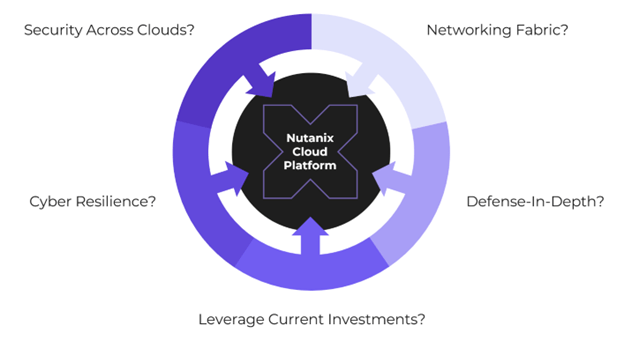
This is possible due to the “many-to-one” security principle employed by Nutanix Flow Network Security. By allowing one virtual machine to be part of multiple security policies, IT teams can have more flexibility when securing workloads in the Nutanix environment.
Step 6: Avoid These Common Multicloud Security Mistakes
Even well-resourced IT teams make predictable errors when managing security across multiple cloud environments. Knowing these pitfalls in advance is the most efficient way to avoid them.
Treating each cloud’s security tools as sufficient on their own. Provider-native tools are designed around that provider’s environment. They do not share data or enforce consistent policies across providers. A centralized layer is always required.
Skipping backup verification. Backing up data is not enough if you do not regularly test that the backup is actually restorable. Many organizations discover their backup is incomplete only when they need to use it.
Over-permissioning service accounts and users. The principle of least privilege is easy to agree with and difficult to maintain. Schedule regular IAM audits and automate alerts for accounts that acquire permissions beyond their defined role.
Using provider-managed encryption keys exclusively. When the provider manages your encryption keys, the provider can access your data. For sensitive workloads, BYOK is the appropriate standard.
Failing to document shared responsibility boundaries. Each cloud provider operates under a shared responsibility model that defines what they protect and what you must protect. Misunderstanding this boundary is a common source of coverage gaps.
Step 7: Implement Multicloud Security With Nutanix
At the outset, securing data in a multicloud environment where each location exists in its own silo sounds like a monumental task. Nutanix helps organizations with hybrid cloud data protection by providing a platform that breaks down silos.
Businesses can count on the Nutanix Cloud Platform to deliver simplicity, agility, and customizability, all without compromising on data security. With included products such as Flow Network Security, NCM Security Central, and far more, Nutanix is the place to get the most out of hybrid multicloud with confidence.
There is so much that businesses can accomplish in the multicloud realm, but guaranteeing success starts with achieving comprehensive security across clouds. Contact us today with any inquiries or to schedule a test drive of the Nutanix Cloud Platform.
Learn more about enterprise data protection and how to build a comprehensive risk management plan.
“The Nutanix “how-to” info blog series is intended to educate and inform Nutanix users and anyone looking to expand their knowledge of cloud infrastructure and related topics. This series focuses on key topics, issues, and technologies around enterprise cloud, cloud security, infrastructure migration, virtualization, Kubernetes, etc. For information on specific Nutanix products and features, visit here.”
© 2026 Nutanix, Inc. All rights reserved. Nutanix, the Nutanix logo and all Nutanix product and service names mentioned are registered trademarks or trademarks of Nutanix, Inc. in the United States and other countries. All other brand names mentioned are for identification purposes only and may be the trademarks of their respective holder(s).