Navigating the True Cost and Capability Gap: Nutanix vs. VMware Explained
By Eddie Ryan, Senior Competitive Economics Strategist, Nutanix
Broadcom’s acquisition of VMware has reshaped the enterprise software landscape, forcing organizations to reevaluate long-standing strategies. Amid this shift, one question dominates boardroom discussions: What is the real cost difference between VMware Cloud Foundation (VCF) and Nutanix Cloud Platform (NCP)?
Comparing Nutanix to VMware by Broadcom isn’t straightforward—these platforms differ fundamentally in architecture, licensing, and feature sets. Yet, misconceptions persist, often leading organizations to assume Nutanix is the pricier option.
For decades, VMware set the standard in virtualization, with Cloud Foundation (VCF) delivered in clearly tiered editions—Starter, Standard, Advanced, and Enterprise—each providing comprehensive, out-of-the-box capabilities. Even at the Starter level, customers received built-in features such as microsegmentation and load balancing, with functionality expanding further across the higher editions.
vSAN imposed no storage-capacity limits because its perpetual licensing model was tied to the number of CPU sockets in the cluster. In other words, capacity was effectively unlimited, as licensing scaled with processors rather than TiB per core limitation. VMware’s Cloud Foundation (VCF) was historically the flagship platform, providing a clear roadmap from individual product sets toward a fully integrated Software-Defined Data Center (SDDC).
It’s important to recognize that pre-acquisition, VMware Cloud Foundation (VCF) differs significantly from today’s VMware by Broadcom Cloud Foundation (VCF).
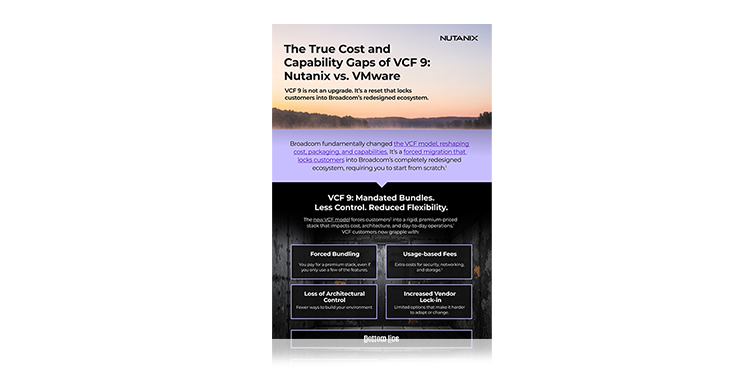
Today, VCF remains VMware by Broadcom’s flagship, but its licensing model and packaging has changed dramatically. Broadcom has consolidated VMware Cloud Foundation (VCF) into a single edition, removing several core NSX capabilities that were previously included and adding new vSAN capacity restrictions. Many of these NSX features, along with the formerly unlimited vSAN capacity, are now only available as paid add-ons. From a customer perspective, this shift has reduced flexibility and increased overall cost considerations for customers—transforming what customers had come to expect . These changes can create hidden costs and capability gaps that many organizations may overlook when comparing solutions.
Comparing VMware by Broadcom Cloud Foundation (VCF) to Nutanix Cloud Platform Ultimate Edition isn’t an apples-to-apples comparison. Nutanix bundles numerous key capabilities by default in the Ultimate edition, including microsegmentation, load balancing, unlimited storage capacity, and built-in disaster recovery.
With Nutanix, customers retain true choice and flexibility through a modular licensing and packaging approach by offering Starter, Pro and Ultimate editions. This approach leverages Nutanix’s highly flexible licensing model, allowing customers to tailor product combinations and editions to their exact requirements—providing a level of agility and choice no longer available under the new VMware by Broadcom structure. With Nutanix, organizations gain the freedom to modernize their VMware environments on their own terms, selecting the precise solutions and editions that match both their technical needs and budget. Unlike VMware by Broadcom Cloud Foundation (VCF), which forces customers into predefined bundles regardless of which components they actually want to use, Nutanix empowers customers with true configurability and cost alignment.
Looking Beyond List Price
When evaluating alternatives to VMware, it’s essential for customers to recognize that each platform’s unique technical capabilities translate into distinct operational and economic outcomes. The long-term financial impact of these differences often extends far beyond the initial software purchase price—which is why a business value consultation becomes critical.
While licensing terms and feature lists may seem straightforward, true total cost of ownership (TCO) extends far beyond the initial purchase price. What organizations gain—or lose—over time depends on how flexible, scalable, and open their platform is.
Most IT teams focus narrowly on software and hardware pricing, the software portion of which typically accounts for only 28% of total IT spend. A far greater cost can come from operational complexity, licensing constraints, and lost agility caused by being locked into rigid product bundles.
Why Choice and Flexibility Matter
The post-acquisition shift to a single, tightly bundled edition eliminates the flexibility customers once had with VMware, forcing organizations into a one-size-fits-all model—often with features they neither want nor use.
Nutanix takes the opposite approach, preserving choice and flexibility in its licensing and packaging, enabling customers to deploy exactly what they need—without redundant or unused features.
While all Nutanix editions include core capabilities such as load balancing and unlimited storage capacity, both the Nutanix Cloud Platform (NCP) Pro and Ultimate editions add more advanced features for organizations that require microsegmentation and built-in disaster recovery functionality—capabilities that VMware by Broadcom Cloud Foundation (VCF) only offers as additional paid add-ons.
The Importance of Total Cost of Ownership (TCO)
Most VMware environments rely on traditional three-tier architectures—compute, storage, networking—requiring separate management, SANs, and significant operational overhead. Nutanix’s hyperconverged infrastructure (HCI) integrates all three layers, controlling costs, simplifying operations, and improving efficiency.
A critical question, therefore, is what is the Total Cost of Ownership of the available solutions? A complete TCO analysis should include:
- Software, storage, compute, and networking costs
- Support and lifecycle management
- Operational resources and overhead
- Scalability and growth costs
- Facilities costs (power, cooling, and datacenter space)
- Migration and professional services costs
By shifting focus from sticker price to lifecycle cost, organizations can make informed, data-driven decisions that align technology investments with long-term business outcomes.
Meeting Customers Where They Are
Nutanix doesn’t force organizations into a predefined future state. Its flexible architecture allows enterprises to transform at their own pace, balancing modernization with practicality while reducing operational complexity.
Key benefits of the Nutanix Cloud Platform solution:
- Freedom of choice across any cloud
- Efficiencies in operational overhead and cost
- Enhanced resilience and scalability
- Avoidance of vendor lock-in with full environment control
Beyond Price: Measuring True Business Value
Short-term savings on licensing can be deceptive. Features moved to paid add-ons often translate into higher operational costs, reduced agility, and increased lifecycle expenses.
TCO isn’t just what a solution costs today—it’s how it supports your organization over time:
- Does it scale as your business grows?
- Does it reduce operational burden or increase it?
- Does it offer freedom or lock you into a single ecosystem?
Nutanix enables organizations to align technology strategy with business outcomes, drive innovation, and optimize long-term ROI.
The Executive Perspective
Flexibility, openness, and interoperability are no longer optional—they are strategic imperatives. Nutanix’s open, hybrid, and multicloud approach helps ensure that organizations remain in control of their technology future, able to innovate at their own pace without vendor-imposed limitations.
A well-defined TCO framework empowers executives to:
- Align technology investments with business goals
- Drive innovation while maintaining fiscal discipline
- Maximize long-term ROI and minimize operational risk
TCO is about what you gain over the lifecycle of your platform, not just the initial purchase price.
Conclusion
VMware by Broadcom Cloud Foundation (VCF) and the Nutanix Cloud Platform solution represent fundamentally different licensing and packaging approaches. VMware by Broadcom limits flexibility, leaving customers with the prospect of incremental costs through add-ons, while Nutanix delivers choice, integrated capabilities, and long-term efficiency.
Organizations that thrive prioritize value over cost, flexibility over rigidity, and long-term vision over short-term savings.

From Cost to Value: Redefining What Success Looks Like
It’s time to move beyond price tags and focus on what truly drives long-term success: value, flexibility, and business agility.
The real measure of technology investment isn’t the initial cost—it’s how well your platform empowers growth, innovation, and control over time.
Ready to reframe your TCO conversation and uncover the true business value of your platform?