The Bedside Revolution: Why the Future of Healthcare AI is Hybrid and Containerized
By Leah Gabbert
In the modern ICU, a single patient room is a data powerhouse, generating overwhelming amounts of data annually. With numerous connected devices per ICU bed, the point-of-care has evolved from a physical location to a sophisticated digital edge.
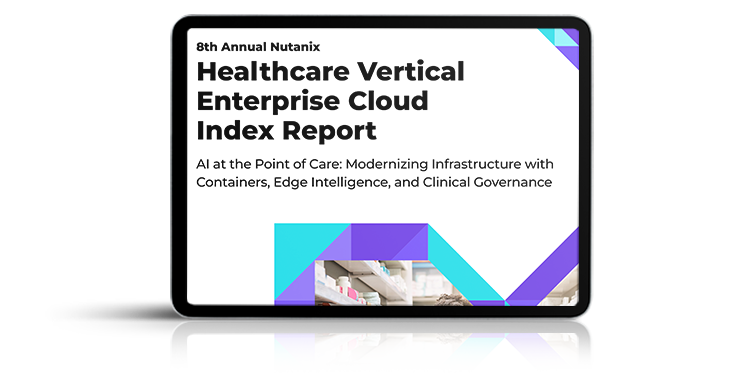
The latest Nutanix Healthcare Enterprise Cloud Index reveals a stark reality for healthcare IT leaders: AI is no longer a "central data center" initiative. It has moved to the bedside. But as AI adoption accelerates, a gap is widening between clinical ambition and infrastructure readiness.
To bridge this gap, healthcare IT must embrace a "dual reality" where containerization and hybrid cloud architectures aren't just IT preferences, but clinical necessities.
The Latency Paradox: Why the Cloud Isn't Enough
For administrative tasks, a slight lag is a minor annoyance. In a clinical setting—where AI monitors heart rhythms or respiratory distress—that same latency can be the difference between a proactive intervention and a reactive crisis.
According to the report, 88% of healthcare IT leaders acknowledge their current infrastructure isn’t fully ready for on-premises AI. The solution? Containers.
- Reliability at the Edge: 86% of leaders see AI as the primary driver for container adoption. Containers allow models to run locally at the Point of Care, ensuring high levels of clinical continuity even if the hospital's external WAN connection fails.
- The Data Gravity Problem: With 75% of healthcare data soon to be generated at the edge, moving that data to a central cloud for processing is increasingly inefficient and expensive.
Perhaps the most jarring finding in this year’s report is the rise of Shadow AI. 79% of healthcare organizations report that employees in non-IT functions are implementing their own AI Taming the "Shadow AI" Beast applications or agents.
While this speaks to a high AI appetite among clinicians and staff, it creates massive business risks. 83% of leaders believe this lack of oversight threatens data sovereignty and regulatory compliance.
The path forward isn't to block innovation, but to provide a governed, hybrid platform that makes it easier for departments to innovate within IT’s secure perimeter. By utilizing a hybrid model, IT can offer the "cloud-like" agility users crave while maintaining the "on-prem-like" control that HIPAA and digital sovereignty require.
From Virtual Machines to Modern Microservices
Healthcare isn't discarding the old for the new; it’s blending them. The report finds that 78% of organizations are running a mix of traditional apps in VMs and modern apps in containers on those same VMs.
Why this matters for your strategy:
- Scalability: 80% of new healthcare applications are being built in containers to ensure they can scale across private and public clouds seamlessly.
- Agentic AI: Over 57% of organizations expect Agentic AI (autonomous assistants) to transform business processes. These agents require the portable, lightweight nature of containers to move between administrative offices and clinical floors.
The Path Forward: From Data Center to Bedside
The "Enterprise Cloud" in healthcare is no longer a place—it's an operating model. By leaning into containerization and hybrid infrastructure, healthcare organizations can finally move AI out of the pilot phase and into the room where it matters most: the patient’s.
Get the complete findings, data, and strategic takeaways from the 2026 Nutanix Healthcare Enterprise Cloud Index.
©2026 Nutanix, Inc. All rights reserved. Nutanix, the Nutanix logo and all Nutanix product and service names mentioned are registered trademarks or trademarks of Nutanix, Inc. in the United States and other countries. All other brand names mentioned are for identification purposes only and may be the trademarks of their respective holder(s).