Modernizing Oracle Infrastructure at Scale with NDB: From Manual Effort to Engineered Resilience
By Sunny Kichloo, Consulting Architect, Nutanix
In many enterprise environments, Oracle database operations don’t fail suddenly—but as the underlying infrastructure ages and complexity builds, they become progressively harder to operate. Maintenance takes longer, recovery processes become more involved, and routine tasks increasingly depend on manual effort. By the time the conversation about modernization starts, the cost of staying put is already real - it’s just spread across enough teams that no single budget line captures it.
That’s the situation many organizations face today. When critical Oracle database platforms approach end-of-life, the decision becomes unavoidable: extend an already brittle model for one more cycle, or use the moment to build something fundamentally different.
We recommend the latter.
By adopting Nutanix Database Service (NDB) on the Nutanix Cloud Platform—whether on-premises or within a hybrid cloud environment—organizations can simultaneously address infrastructure lifecycle challenges and longstanding operational inefficiencies. This is not just a hardware refresh; it is an opportunity to simplify and modernize database management in a meaningful way.
Nutanix has supported many customers through this transition. It requires planning and discipline, but the outcome is clear: a modern database platform that removes operational friction and reduces reliance on manual processes—gives DBAs and IT teams a far more predictable and scalable operating model.
The Operational Baseline: What “Before” Typically Looks Like
To understand the need for change, it’s important to examine the realities of legacy Oracle environments. These environments often suffer from consistent and repeatable operational challenges. Here are some typical situations in organizations staring at their legacy environment and wondering how to make their Oracle database infrastructure perform better at scale:
1. Non-Deterministic Provisioning and Refresh Cycles
Database provisioning and refresh processes for QA, UAT, and development environments are often manual and time-intensive. Traditional RMAN-based workflows can take hours—or even overnight—and are prone to failure. Any interruption or inconsistency forces teams to restart the process, causing cascading delays for application teams and slowing overall delivery timelines.
Patching typically follows a similar pattern: maintenance windows must be negotiated across multiple teams, execution remains heavily manual, and rollback procedures rely more on individual expertise than on consistent, documented automation.
2. Disaster Recovery That Exists More in Design Than Practice
Disaster recovery architectures and runbooks are often well documented, but regular failover testing just as often is not part of the operational rhythm. Executing DR drills is, of course, disruptive and time-intensive. Yet without regular drills, there is significant risk of gaps between what was written and what actually works in practice. It can take just one event to regret a lack of practice
During a recent customer engagement, the customer team encountered inconsistencies such as unversioned scripts, misaligned assumptions between teams, and unclear ownership of recovery steps. As a result, DR testing became difficult to sustain and readiness suffered. Fast forward to a happy ending: A change to modern infrastructure allowed regular DR testing to become a sustainable operational process.
3. Cost-Constrained Architecture and Limited Agility
Infrastructure scaling discussions always are constrained by practical necessities, most importantly, keeping the legacy system operational for the business. Proactive investment opportunities get backburnered because they require significant planning, cross-team coordination, and risk evaluation. Over time, systems become increasingly stretched, and the environment grows harder to scale in a predictable and controlled manner. Agility is lost.
The question for you, dear readers, is whether these common situations with legacy architectures supporting Oracle databases ring familiar? If “yes,” or even if “maybe”, then it's time to consider infrastructure modernization. Extending the existing infrastructure on new hardware solves nothing structurally—it merely defers the same problems for another five or so years at significant cost.
Introducing NDB and Why It Matters for Modernization
The convergence of legacy hardware reaching end-of-life and contract renewal discussions with legacy infrastructure vendors creates a natural window to rearchitect rather than simply re-platform. At this point, platform and operations teams typically align on two foundational principles:
- Automate the database lifecycle so that human intervention is no longer the critical path for routine operations
- Treat disaster recovery as a platform capability—not a collection of scripts and documents
Nutanix Database Service (NDB), running on Nutanix Cloud Infrastructure (NCI), or on Nutanix Cloud Clusters (NC2) in the public cloud, is designed to address these requirements directly. It provides policy-driven provisioning, snapshot-based cloning and refresh, orchestrated patching, metadata-driven lifecycle management, and native multi-cluster high availability—all within a unified platform. Importantly, its disaster recovery capabilities are not theoretical—they are validated, repeatable, and operationally consistent, providing reliable execution beyond lab scenarios.
NDB is a Database as a Service platform that brings lifecycle management, standardization, automation, and governance to enterprise database operations. It abstracts the complexity of deploying, managing, and sustaining databases, while still preserving control for DBAs and platform teams.
For organizations running Oracle on legacy platforms (such as Solaris or fragmented x86 environments), inefficiencies tend to compound over time:
- Environment provisioning becomes inconsistent and slow
- Patching cycles are risk-heavy and dependent on maintenance windows
- Disaster recovery exists in design but lacks execution confidence
- Migrations are treated as one-off, high-risk events
NDB addresses these challenges through:
- Profile-driven standardization across OS, database, and infrastructure layers
- Automation-first lifecycle operations, including provisioning, patching, cloning, and DR
- Policy enforcement and guardrails, reducing reliance on manual processes
- End-to-end visibility and control via UI, API, and CLI
Rather than replacing DBA expertise, NDB encodes operational knowledge into repeatable workflows, making outcomes predictable at scale. When deployed on NCI or NC2, it enables a unified DBaaS model across Oracle, SQL Server, PostgreSQL, MySQL, and MongoDB—while maintaining enterprise-grade performance and resilience.
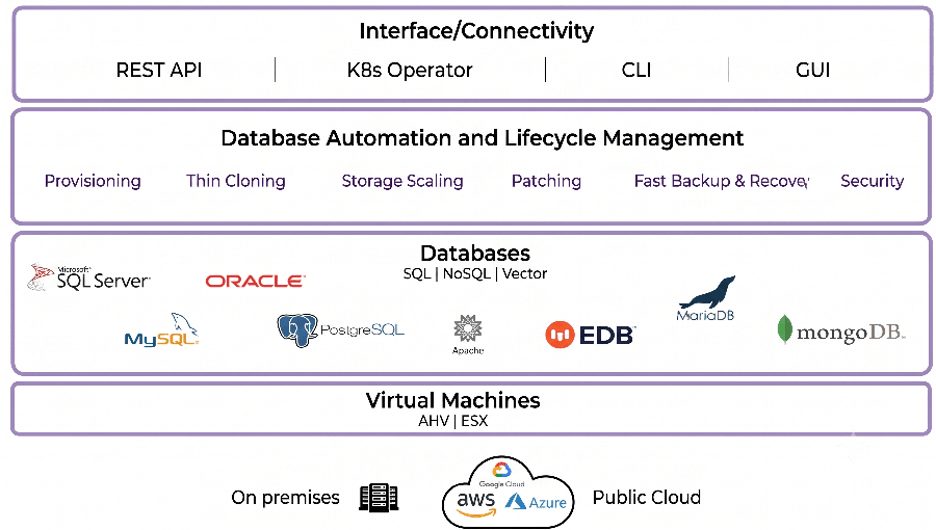
Figure 1: NDB — a single DBaaS platform for Oracle, SQL Server, PostgreSQL, EDB, MongoDB, MySQL, and MariaDB.
Modernizing with NDB – What You Can Expect
Modernizing database operations with NDB is not a single-step transformation. It is a structured progression that incrementally improves operational maturity while reducing risk. Across customer environments, this journey typically unfolds in four logical stages:
Stage 1: Standardized Provisioning and Clone Automation
The Challenge
Assume QA and UAT refresh cycles are routinely slipped, delaying sprints and increasing defect leakage. Refreshes that should have taken hours were consuming overnight windows, often dependent on manual DBA execution. Sound familiar?
What Changes with NDB
- Golden database profiles standardize deployments across OS, database, and infrastructure layers
- Snapshot-based, space-efficient cloning replaces RMAN-heavy workflows
- Post-clone automation ensures every refreshed environment is consistent
- Policy-based scheduling via Time Machine introduces control and predictability
In Practice
Development teams often request frequent refreshes—including ad-hoc cycles. While technically feasible, unmanaged execution introduces instability. With NDB, refresh demand is aligned to policy-driven schedules, providing both flexibility and platform discipline.
Target Outcome
Provisioning and refresh operations move from manual effort to repeatable, on-demand workflows. Environment consistency improves, and sprint timelines become more reliable.
Example
Check out Westgate Resorts Transforms into a Mecca for IT Modernization.
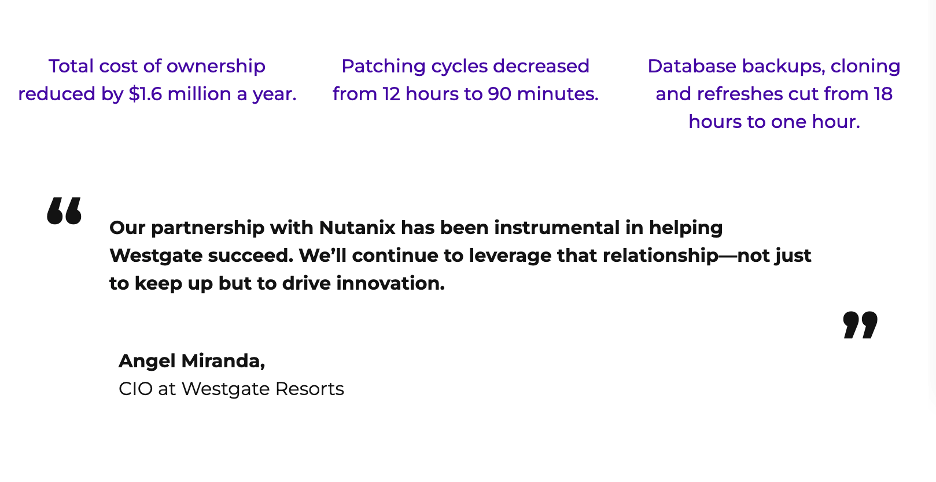
Figure 2: Westgate Resorts Highlighting NDB Capabilities.
Stage 2: Policy-Driven Patch Orchestration
The Challenge
Assume patching requires extended maintenance windows, often entire weekends. With rollbacks dependent on manual validation, increasing operational risk. Sound familiar?
What Changes with NDB
- Patch profiles define approved versions, binaries, and validation checks
- Rolling patch automation reduces downtime and risk
- Built-in health validation gates enforce correctness at every stage
- Lineage-aware rollback enables fast recovery to known-good states
In Practice
When an application incompatibility surfaces during patching, NDB allows selective rollback and captures that exception into the patch profile. Over time, operational experience becomes embedded into automation, avoiding repeat incidents.
Target Outcome
Patching transitions from a high-risk, time-consuming activity to a controlled, auditable, and significantly faster process across all managed databases.
Example
Check out Nutanix Database Service Drives Efficiencies and Business Growth for Yelo.
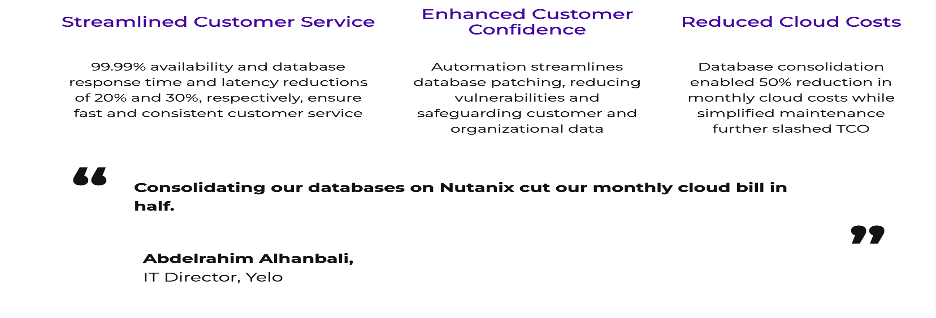
Figure 3: Yelo highlights Nutanix NDB for enabling effortless, zero‑downtime database patching.
Stage 3: Codified Database Disaster Recovery
The Challenge
Assume disaster recovery setups exist but are rarely tested. Manual runbooks, fragmented tooling, and lack of confidence make DR exercises infrequent. Sound familiar?
What Changes with NDB
- Oracle Data Guard integration (from NDB 2.9 onwards) enables native DR
- DR is provisioned as part of the database lifecycle—not as a separate effort
- Multiple topologies (single, cascaded, multi-standby) are supported
- Switchover, failover, and switchback are executed via unified workflows
In Practice
Instead of custom-built DR setups per application, organizations can adopt a standardized DR model across environments. Testing becomes easier because the execution path is automated, consistent, and observable.
Target Outcome
DR evolves from a theoretical capability into a regular, repeatable operational exercise, with RTO/RPO targets consistently met and validated.
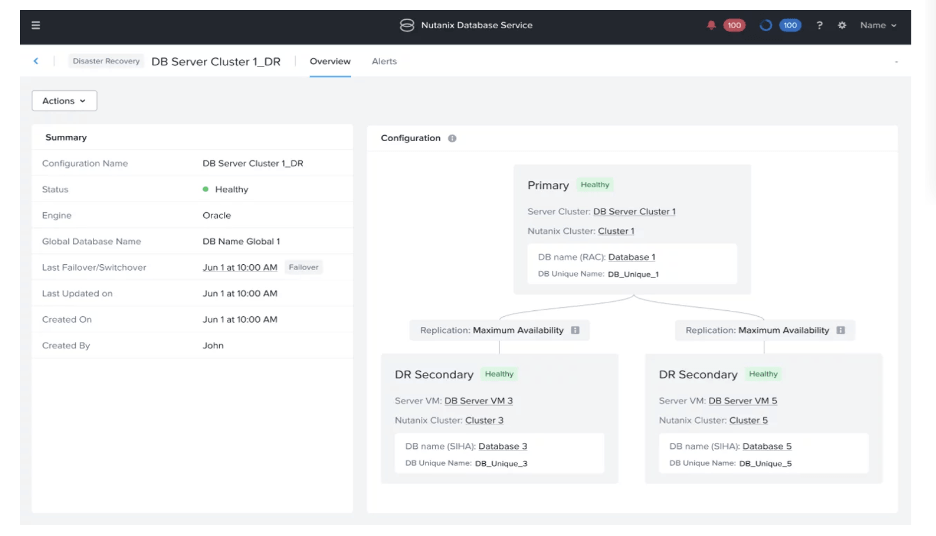
Figure 4: NDB Disaster Recovery UI — provisioning a DR cluster in a multiple standby configuration.
Stage 4: Large-Scale Solaris-to-Linux Database Migration
The Challenge
Assume migrations from legacy platforms such as Solaris to Linux are necessary. Common wisdom is: these are complex, resource-intensive, and difficult to restart if disrupted mid-process. Challenge is: how to make migrations routine and less of a headache?
What Changes with NDB
- Migration workflows are structured using SDK-driven orchestration frameworks
- Target environments are pre-standardized using NDB profiles
- Post-provisioning Day 1 parity across all migrated systems
- Cutover processes become repeatable instead of one-time events
In Practice
If a planned cutover is delayed—for example, due to application freeze windows—the migration does not need to restart from scratch. Because the target environment is already standardized, teams can resume execution without re-validation or re-staging.
Target Outcome
Migrations become low-risk, repeatable engineering workflows rather than high-stakes events. Even large, multi-terabyte databases can be transitioned with minimal disruption and no post-cutover inconsistencies.
Under the Hood: What Makes NDB Ideal for Modernizing Oracle Workloads at Scale?
NDB has been the cornerstone of modernization efforts at many customer organizations, enabling database administration teams to overcome challenges like those described above. There’s a simple explanation: NDB is designed, from the ground up, to make database management simple, reliable, and scalable from Day 1 through years of Day 2 operations. Here are some of the designed-in capabilities that allow NDB to help customers to achieve such targeted outcomes.
Profiles and guardrails. Every managed database is deployed against a golden profile—OS version, Oracle binaries, parameter baselines, TDE enforcement, I/O classes. Profiles help reduce configuration drift by making deviation structurally difficult, not just discouraged.
Snapshot-lineage cloning. NDB combines Nutanix AOS storage snapshots with post-clone automation to rapidly produce environment-consistent clones. The lineage metadata is what enables both rapid refresh and deterministic rollback—the platform always knows what state any database came from.
Patch orchestration with encoded exceptions. NDB’s patch engine doesn’t just run scripts—it validates preconditions, gates each stage on health checks, and records exceptions back into the profile. Operational knowledge that would otherwise live in someone’s head becomes part of the automation.
DR as executable logic. Cross-cluster replication, promotion workflows, DNS updates, and application hooks are encoded as NDB operations—rather than relying solely on manual documentation.The difference between a DR capability that exists and one that can be exercised confidently is whether the execution path is automated and observable.
Architectural Lessons Learned
The NDB team and the Services team at Nutanix have helped many customers on their unique modernization journeys. For enterprise customers evaluating a similar modernizing journey, the following emerge as guiding principles to success.
- Automate high-frequency operations first—provisioning, cloning, patching, protection. Wins here create the operational confidence that enables harder changes.
- Treat DR like Continuous Integration: frequent, automated, observable, and boring. If DR testing is an event, it won’t happen often enough.
- Use telemetry and profiles to depersonalize sizing and capacity decisions. Institutional knowledge is a risk, not an asset.
- Encode exceptions as policy, not tribal knowledge. Every incident is an opportunity to harden the automation.
- Plan migrations as repeatable engineering programs, not one-off events. Standardizing the landing zone first is what makes reruns possible.
Closing Perspective
Nutanix Database Service running on a modern HCI or hybrid cloud platform - which Nutanix delivers via its Nutanix Cloud Platform - does not eliminate the tasks of provisioning and managing databases and keeping Oracle databases - and other popular SQL, NoSQL, and Vector databases - operational, updated and secure — but NDB can significantly reduce the complexity and burden on the IT/DBA team while at same time improving efficiency, scalability, and security. By making routine operations predictable and risky operations repeatable, the organization is shifted from reactive database management to confidently operating a platform with engineered resilience.
In large enterprises, that confidence is not a soft benefit. It is a performance characteristic.
If your Oracle environment is approaching an inflection point—aging hardware, licensing pressure, DR gaps, or modernization demands—the NDB team and Nutanix Services are available to walk through what a scoped engagement looks like for your environment.
For More Information