Excitement over GPUs and new AI applications has evolved into deep concerns about data sovereignty, legacy workload management and cybersecurity. The marketplace is flooded with AI vendor offerings, stretching the CIO's job between signal filtering and strategy setting. Just ahead is a fast-approaching category called AI agents. All of these strain IT decision makers who feel they must speed up their assessment of unknowns and risk management, according to analyst Scott Sinclair, practice director at Omdia.
Sinclair sees the pace and scale of unknowns unleashed by AI eclipsing the seismic shift of early public cloud adoption. For IT leaders navigating this moment, the challenge isn't just adopting AI, it's doing so without leaving the organization exposed, overwhelmed or outpaced by the very tools they're trying to manage.
"I can't think of a timeframe where there's just been this combination of scale of [what’s] unknown as well as rapid evolution in innovation happening all at the same time," Sinclair said in an interview with The Forecast, captured in April at the 2026 .NEXT event in Chicago.
"It's unprecedented."
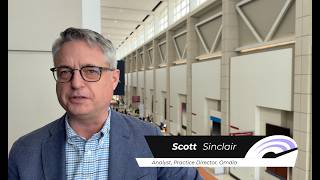
Sinclair leads a team covering infrastructure, cloud, DevOps, and networking. He said this unprecedented pace of change forces IT leaders to grapple with complex challenges, from ensuring data sovereignty and locality to navigating a noisy landscape of vendor partnerships. Underpinning it all is a growing reliance on solid hybrid IT operations to accelerate the adoption of enterprise AI capabilities without compromising data security.
He described the initial focus of the AI boom was on compute power, with organizations scrambling to acquire GPUs. Now, however, attention has shifted to managing and protecting data. Enterprises recognize that to effectively leverage AI, they must have their data under control, stored correctly, and able to move efficiently.

This drives on-premises data center investments and hybrid cloud strategies. Sinclair explained that IT organizations are carefully considering where their data resides and how it moves to feed new AI applications and existing workloads. This, in turn, has many reevaluating how they manage virtual machines as they adopt more containerized applications.
"All of these modernization initiatives spurred from artificial intelligence, but it's really permeating kind of all aspects of IT, and not just new apps, but also looking back to existing applications," he said.
Data Security: Job One in the Age of Enterprise AI
Sinclair explained that AI presents tremendous opportunities for business growth. It also introduces new risks and vulnerabilities to bad actors who use advanced generative AI tools to spear-phish and run ransomware-as-a-service operations that threaten organizations. Still, CIOs and IT decision-makers are forging ahead to adopt new AI hardware and capabilities, aiming to do so without adding undue risk to operations.
"As you start to adopt new technologies or integrate new initiatives, it's all about, okay, how do we take this unknown and turn it into a known so we can ensure that we are putting the right level of security and controls on top of it and doing the right things we can to best protect our business," said Sinclair.
Navigating the Noise of Partnerships
In the interview, Sinclair also described the rapid rise in collaborations and partnerships across the technology industry. He said the rapid pace of AI innovation means no single company can offer a complete, end-to-end solution. He sees partnerships as essential for organizations to stay current and avoid being left behind. While these collaborations provide valuable pre-validation and risk reduction, he warned that the recent flurry of partnerships creates noise and confusion for buyers.

He explained that with every vendor touting an AI story, the burden falls on the CIO and their team to parse the signal from the noise. They must carefully evaluate each potential partner, understanding how their specific "building block" fits into the broader IT strategy and how best to leverage their capabilities.
The Nascent World of AI Agents
Sinclair said one of the most talked-about developments in the AI space is the rise of AI agents. While current enterprise adoption largely focuses on knowledge management and customer support, there is growing interest in using agents for more complex tasks, such as root cause analysis and automated remediation.
However, he cautions: these are still the early stages of this evolution.
"I think this is going to be a rapidly evolving space,” he said. “It's going to be where different organizations just have a different level of risk appetite to where, how they want agents to work and how quickly they're able to adopt them."
He advises IT leaders to remain agile and adaptable. Stick to core principles of data security and infrastructure modernization. He said that by embracing the unknown and partnering strategically, organizations can harness the power and promise of enterprise AI.

Video interview transcript:
Scott Sinclair: I mean, it's hard to talk about any trend without talking about artificial intelligence, right? So that's something that's been pervasive across all organizations. Seen, of course, tons of interest and excitement. We saw a lot of investment from the neo clouds. Now enterprises are getting involved. So what does that mean? We saw this massive uptick in GPUs and excitement around compute several years ago. That's continuing, but now we're seeing the focus turn to data, which we all expect it to happen, but now enterprises are saying, wait a minute, we not only need to get our data under control, but we also need to make sure we store it correctly as well as move it. So there's thoughts around what does this mean for data storage? What does it mean for networking and what does it mean for infrastructure overall? At the same time related to just artificial intelligence, organizations as they become better, they start to better understand their data.
They realize, hey, data sovereignty, data locality matters. So what does this mean? It means, okay, now we're starting to think, okay, should we invest more on premises? Think about data center investments and start to take more of a hybrid cloud strategy, as we think about where data is and where it's stored and where it moves. And particularly as it relates to not just new applications, but also saying, okay, well, if we're taking a more hybrid cloud strategy to this new innovation around AI, what does that mean for existing workloads? And then that also turns back to a lot of things around, okay, what does it mean for my hypervisor, my VMs, and then how does that help me accelerate containers? So all of these modernization initiatives, it kind of spurred a little bit from artificial intelligence, but it's really permeating all aspects of IT and not just new apps, but also looking back to existing applications.
But the big challenge that every CIO and every CEO cares about is around cybersecurity, right? That's job one that has to be secured. And one of the fascinating things, particularly as it gets back to data and artificial intelligence, now you're talking about not just great new potential for business, but also new potential for not only bad actors, but potential for new areas of exposure, for how you're leaking sensitive data or your most important or your vital data out into the world.
The challenge for IT decision makers or CIOs is how do I help my business accelerate its adoption of new innovations, such as artificial intelligence, but do it in a way that is secure and doesn't add additional risk to our own operations. You have your known, and then you have the unknown, and I think that's really what it's about. As you start to adopt new technologies or integrate new initiatives, it's all about, okay, how do we take this unknown and turn it into a known, so we can ensure that we are putting the right level of security and controls on top of it and doing the right things we can to best protect our business.
Related Articles:

Ken Kaplan is Editor in Chief for The Forecast by Nutanix. Find him on X @kenekaplan and LinkedIn.
Jason Lopez contributed to this video. He is executive producer of Tech Barometer, the podcast outlet for The Forecast. He’s the founder of Connected Social Media. Previously, he was executive producer at PodTech and a reporter at NPR.
© 2026 Nutanix, Inc. All rights reserved. For additional information and important legal disclaimers, please go here.
Related Articles