Synthetic media cuts both ways. In early 2025, Forrester named high-quality AI deepfakes among the "top threats" facing organizations. Recent entertainment mergers have triggered alarm among creatives who see AI capabilities threatening jobs and content diversity.
The number for all AI-generated video platforms and tools is growing fast as they empower creators to realize ambitious visions without massive budgets or investor gatekeepers. Revolutionary ideas now sit just a prompt away from reality.
"AI's ability to understand and create complex visual content brings unprecedented opportunities and challenges for content creation, entertainment, and production," Liu Xingliang, director of Beijing's Data Center of China Internet, told China Daily in 2024.
"Video-generation models will help creators turn ideas into reality faster and cheaper, offering audiences richer, more diverse visual experiences."

OpenAI's Sora 2, released in early 2025, exemplifies this shift. Users craft hyper-realistic video through text prompts specifying subjects, locations, actions, lighting, movements, and cinematography. This gives people tools for visual storytelling and creative expression.
Dismantling Production Barriers
By making video creation instantaneous and inexpensive, AI is demolishing traditional gatekeeping. Culture increasingly flows from the sidewalk rather than the boardroom.
"Sora empowers creators of all ages to explore ideas more quickly," Graham Morehead, artificial intelligence professor at Gonzaga University, told The Forecast.
"This video quality is remarkable. Hollywood's storyboarding tradition could transform to generate your entire movie in AI first, then film with actual actors."

Visual effects, once requiring teams of specialists and massive budgets, are now accessible to individuals. AI autonomously generates detailed environments and intricate sequences, fundamentally reshaping not just CGI but filmmaking itself.
While 2023 was AI video’s breakout year, AI video tools have evolved rapidly, according to Justine Moore, a partner at investment firm Andreessen Horowitz (a16z), who reports on the rise of "agentic" video workflows.
“2026 is the year we let agents edit it,” she said in a January 2026 video blog post, where she explains how AI agents can manage the entire creation process from raw footage to finished product.
She notes that AI has moved from simple generation to handling complex post-production tasks such as editing, lighting adjustments, and audio cleaning.
“Video agents will blow out the supply curve for quality video, the kind of content that requires days (or weeks) from professional video editors today,” she wrote.
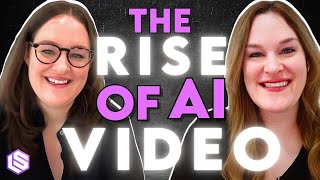
Justine and Olivia Moore cover many of the fascinating trends and memes around AI video generation in AI is Eating the World, the AI Engineer video podcast.
Beyond Entertainment
AI video's potential extends far beyond screens. In education, teachers could deploy AI-generated simulations to illuminate complex concepts.
"We can now train ourselves in simulated environments that previously cost enormous sums," Morehead explained.
"Imagine learning physical skills in virtual environments you create from scratch—instant, personalized training scenarios."


In healthcare, AI video could revolutionize medical education through procedure visualization and scenario simulation. For patients, it offers clearer instructions on physical therapy and home care.
"AI could transform low-resolution orthoscopic camera feeds into high-definition imagery," Morehead noted.
"The doctor's view inside your body during surgery could improve exponentially, potentially saving lives."
About 60% of Reuters’ newsroom is using AI, according to a November 2025 article by Digitday. The most proficient AI users – which make up about 50 to 100 people, out of Reuters’ 2,500 journalists – are using AI to “vibe code” and help with investigative journalism, according to Rob Lang, newsroom AI editor at Reuters. He is helping the newsroom use agentic AI to create rough cuts of video news stories.
The Technology Powering the Revolution
AI-generated video requires extraordinary computing power, Morehead explained.
"You need massive GPU banks for training," he said. "Grok 4's text model alone trained on roughly 300,000 top-tier GPUs."
Cloud infrastructure proves essential. Each GPU maintains its own model copy and predicts subsequent video frames. All 300,000 models train simultaneously, then synchronize through central repositories, a choreographed dance of distributed computing.

That hardware powers the software tools like Sora, which is built from DALL·E and GPT models. The Sora System Card describes how creators can make videos up to 1080p resolution (20 seconds max) in various formats, generate new content from text, or enhance, remix, and blend their own assets. Sora’s diffusion model gradually transforms a base video clip by removing the noise over many steps. This gives the model foresight of many frames at a time, the subject stays the same even when it goes out of view temporarily. Watching the process is like seeing magic.
Navigating Challenges
Pioneering technologies always surface novel problems. Filmmakers worry about the accelerating pace of Hollywood job cuts. Environmental concerns mount over the power and water consumption of AI data centers.
Deepfakes pose authenticity crises. Seeing no longer guarantees believing. Sora 2 recently blocked videos depicting Martin Luther King Jr. after his estate protested "disrespectful depictions."

Yet believers emphasize AI video's transformative potential: democratizing content creation, empowering creativity, enhancing education, and saving lives.
"I suspect vastly more video will be generated this way—perhaps a million times more than we ever made with cameras," Morehead predicts.
Given video's unmatched power to entertain, instruct, and inform, that proliferation might prove beneficial.

Chase Guttman is a technology writer. He’s also an award-winning travel photographer, Emmy-winning drone cinematographer, author, lecturer and instructor. His book, The Handbook of Drone Photography, was one of the first written on the topic and received critical acclaim. Find him at chaseguttman.com or @chaseguttman.
© 2026 Nutanix, Inc. All rights reserved. For additional information and important legal disclaimers, please go here.
Related Articles