For at least 2,000 years — maybe longer — drawings of felines, birds, fish and human figures known as geoglyphs lay undetected across the cliffs of the Peruvian desert. Over a six-month period in 2022 and 2023, archaeologists finally found them with the help of artificial intelligence.
The landmark discovery was part of a joint project between Japan’s Yamagata University and IBM. Using AI to analyze thousands of high-resolution aerial images alongside satellite and drone datasets, archaeologists detected faint soil contrasts in the Nazca region of Peru. After sending team members to walk the area, researchers confirmed the discovery of 303 previously unknown geoglyphs, doubling the catalog of Nazca Lines and revealing a wealth of new insights into one of the world’s most mysterious archaeological treasures.
“We are facing a tool that multiplies our exploration capabilities,” project leader Masato Sakai told The Jerusalem Post in 2025. “AI was able to process in months what would have taken us decades with traditional methods.”

In its own report about the discovery, The Art Newspaper noted that AI makes it possible for archaeologists to scale their work at a rate previously not possible. Using traditional methods, archaeologists working in the Peruvian desert discovered 1.5 geoglyphs per year. For scholars using AI on the Yamagata University and IBM project, the rate was 18.7 per year — 12 times faster.
AI and Archaeology: The Power of Data-Driven Discovery
What happened with AI and Nazca Lines archaeology is happening across the field of archaeological research, according to Blaine Fisher, a professor of information technology, emergency management, archaeology and GIS/remote sensing at at Tulane University.
“By using AI-powered image analysis and pattern recognition, archaeologists are turning to technology to dramatically accelerate archaeological research,” Fisher told The Forecast in an interview.
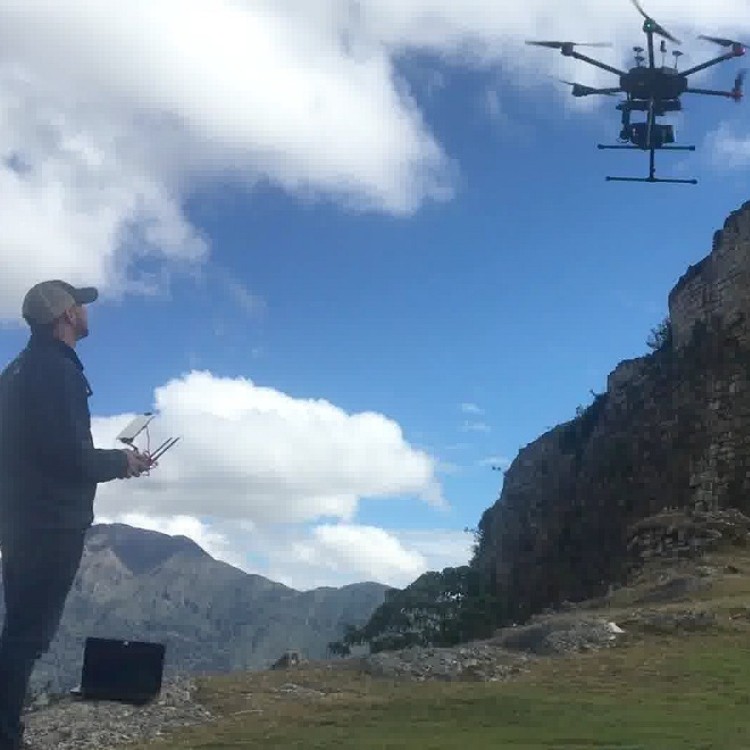

Fisher said the use of LiDAR and geographic information systems creates a very high volume of archaeological data. However, processing this level of data manually is exceptionally time consuming. Additionally, humans can miss patterns or connections between datasets, he explained.
“Archaeology, like every other industry in the world, is moving to become very data-informed,” Fisher continued.
“In the past, we often operated on a hunch, which isn’t the best use of grant money. Now we can make more data-driven choices using AI prediction analysis. We can identify a likely area where a site can be because of all the disparate factors, including the right elevation, the right time, the right place, the right hydrology assessment of that region and vegetation based on other sites in the area.”
Finding Sites and Putting the Pieces Back Together
Because the field of archaeology starts with finding ancient sites, many archaeologists are now turning to AI to detect new, undiscovered places. In 2023, for example, researchers looking for new sites in the Mesopotamian floodplains reported using 5,000 examples to create a dataset to pretrain models for semantic segmentation, fine-tuned on satellite imagery and masks of site shapes. By using these deep learning models, the researchers improved the accuracy of their site detection efforts to 80%.

Once a site is discovered, archaeologists can improve their research by using AI to restore found artifacts, making it possible to learn more about ancient civilizations. The European Union-funded REPAIR PROJECT, for example, used autonomous AI-controlled robots to assemble fragments and restore the frescoes on a painted ceiling in Pompeii.
“Pompeii contains thousands of fresco fragments, and it is close to impossible for a human to reconstruct all the irregular shards into big, meaningful paintings,” Arianna Traviglia, one of the principal researchers on the project, told the journal Nature in 2023. “Technology now allows us to reassemble them from myriad pieces. The robot we use is equipped with two soft humanoid arms, high-definition scanners, cameras and 3D digital-recognition software.”

While AI discourse often focuses on biases created in AI models because of flawed training data, AI in archaeology can actually help reduce biases, according to Emily Hammer, associate professor of digital humanities at the University of Pennsylvania. In September 2025, she told Nautilus that archaeologists gravitate to certain types of places and sites.
“[Archaeologists] like to excavate temples and wealthy tombs and palaces, so the everyday person’s life is sometimes left out of that narrative,” explained Hammer, who said AI might be able to help archaeologists find more subtle structures — for example, the modest places where average people once lived.
Keeping Humans at the Center of Archaeology
While AI provides great benefits to archaeology, it also brings risk — especially if used incorrectly, noted Fisher, who said archaeologists must view AI as a co-researcher on their projects, not as an immutable source of truth.
While research processes may be changing, it’s important that the fundamental rules of research stay the same, argued Fisher, who said researchers should be able to reverse engineer AI outputs in order to understand how AI models generate their conclusions. Because hallucinations are a concern, he also said archaeologists should verify the accuracy of all training data before they rely on a given model.


“One of the rules of the road in research has always been that just because it’s on the internet doesn’t mean it’s correct. The same is true with AI,” Fisher told The Forecast. “In archaeology, theories are debunked all the time. At the same time, archaeologists have opposing thoughts on current feelings. As a result, just because it was published in a book and used as training data doesn’t mean that it’s current, either. Archaeologists must really insert themselves into the model to ensure accurate data is used.”
Archaeology is more than data, added Hammer, who said archaeologists using AI must resist the urge to replace all or even the majority of their processes with technology. Because accurate interpretations of history require the knowledge of indigenous peoples who lived on the land, field research should remain a key part of archaeology, she stressed.
“As digital archaeologists, we believe in the power of our tools to tell an important part of the ancient story, but I don’t think we’re ever going to replace going into the field,” Hammer told Nautilus. “If we were to conflate things that happened in one place, without excavation, we wouldn’t have an accurate picture of history at all.”
Given how essential humans are to archeology, it’s doubtful that technology will ever replace archaeologists digging in the field. But by partnering with AI to identify promising excavation sites, reconstruct damaged artifacts, and analyze enormous datasets, it’s clear that those archaeologists can spend less time searching and more time understanding the civilizations they uncover.

Jennifer Goforth Gregory has written for Microsoft, Adobe, IBM, Google, Salesforce, Verizon and AT&T. In her spare time, she rescues more than 130 homeless dachshunds each year and finds them new forever homes.
© 2026 Nutanix, Inc. All rights reserved. For additional information and important legal disclaimers, please go here.
Related Articles